Planning a Cycling Holiday in Europe: Fitness, Solo Travel, E-Bikes & Bike Logistics Explained

If you are planning a cycling holiday in Europe, the excitement of choosing between Alpine cols, Tuscan vineyards, and coastal fjords often comes with a quiet list of practical doubts. You might be wondering whether your current weekend mileage is enough for back-to-back mountain days, whether you will feel out of place joining a group on your own, or whether flying across the world with a carbon road bike is worth the airport stress.
Over the past decade of leading riders across Europe and beyond, I have spoken with hundreds of keen leisure cyclists—from the UK, the US, Canada, Australia, and New Zealand—who nearly talked themselves out of a bucket-list trip because of those exact questions. If you are looking for honest help finding the best cycling holiday in Europe for your ability and travel style, this guide breaks down the six biggest pre-booking concerns we hear every week—and shows how a properly supported tour removes the friction so you can focus on the ride.
What this article discusses:
- Supported tours make challenging routes more accessible: Leisure cyclists do not need to be racers, but should match their fitness to the terrain: rolling routes generally suit riders comfortable with 45–60 miles, while mountain tours call for a solid base of hilly weekend riding. Lead and sweep guides, summit regrouping, and a support van help riders manage their own pace and take breaks when needed.
- A simple training plan can prepare riders for multi-day cycling: The article recommends building endurance, adding back-to-back rides, and practising climbing, fuelling, and hydration over a 12-week period. Riders should taper during the final 7–10 days before the tour.
- Open-date trips help solo travellers and small groups connect: Scheduled tours bring together individuals, couples, and small groups from different countries, so guests are not joining an established club group. Riders can choose to share a room where available or book private accommodation, and groups reunite at stops and in the evenings.
- E-bikes can help partners ride together at different fitness levels: On selected tours, e-bike rentals can make steep gradients more manageable for riders with less training or physical limitations. They still pedal and ride the route, but can keep closer company with fitter partners or friends.
- Tour support and transparent inclusions reduce travel worries: The guide describes options for bringing a bike or hiring one locally, along with van support for mechanical problems, fatigue, and changing weather. Tour pricing is presented as covering key services such as accommodation, breakfasts, luggage transfers, airport transfers, and ride support.
Quick-Reference Summary: Your Pre-Booking Worries vs. Supported Reality
| Your Pre-Booking Worry | What Usually Happens on a DIY Trip | How a Supported ECT Tour Handles It |
| “I’m not fast enough for big climbs.” | You ride alone off the back or struggle under heavy bikepacking bags. | Ride at your own pace with lead and sweep support, summit café regroups, and an air-conditioned support van close by. |
| “I’m travelling solo—will I feel left out?” | Eating alone every evening and navigating unfamiliar roads solo. | Scheduled open-date trips bring together individuals, couples, and small groups worldwide, creating instant camaraderie. |
| “My partner or friend climbs faster than me.” | One rider waits at every summit while the other pushes into the red. | E-bike rentals are available on selected European tours, allowing mixed-ability partners to climb side-by-side. |
| “Flying with my bike looks stressful.” | Oversize baggage fees, taxi refusals at airports, and DIY assembly. | Bring your own bike (with designated airport transfers included) or opt for locally fitted carbon road or e-bike hire. |
| “What if I get a mechanical or bad weather?” | Hunting for a rural bike shop in a foreign language or getting caught in a storm. | Our support van carries tools, spare wheels, and backup bikes, while guides monitor mountain pass weather in real time. |
| “Are there hidden costs once I arrive?” | Surprise luggage transfer charges, hotel tourist taxes, or transfer fees. | Transparent pricing covering 3- and 4-star hotels, breakfasts, luggage transits, airport transfers, and full ride support. |

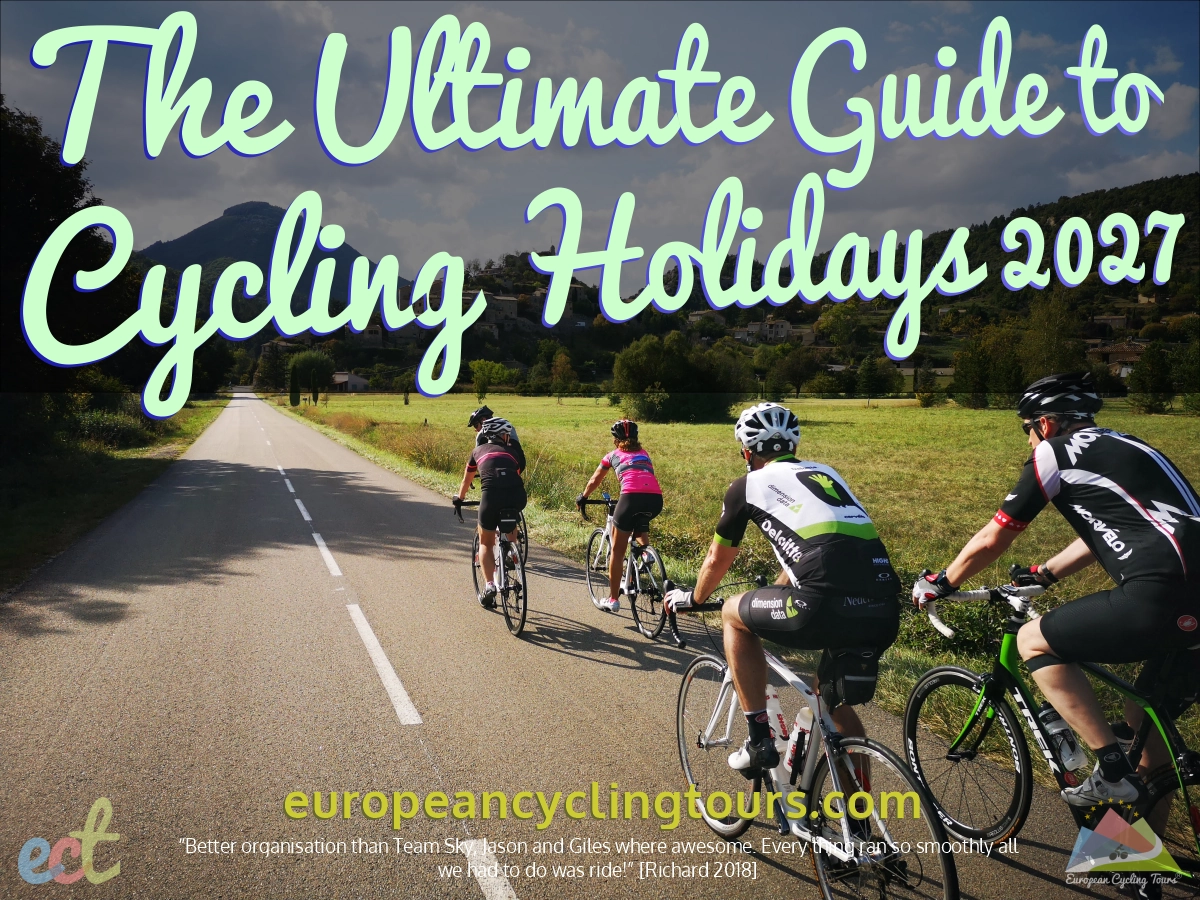
“A group of cyclists enjoying a smooth, shaded asphalt road during a professionally supported European cycling holiday.”
Am I Fit Enough, and What If I Get Dropped – Especially on the Climbs?
Conquer the cols, leave the anxiety behind.
This is, without question, the number-one hesitation I hear from cyclists considering their first continental tour. Many riders assume that multi-day European cycling holidays are reserved for semi-pro racers with single-digit body fat and 10,000 annual miles in their legs. They are not.
Realistic Fitness Benchmarks for a Multi-Day Tour
Our open-date trips are built for keen leisure cyclists—typically aged between 30 and 60+—who love riding their bikes and want a rewarding physical challenge without feeling like they are in a race. As a practical rule of thumb:
Rolling & Coastal Tours (e.g., London to Paris, Norway Atlantic Coast, Venice to Pisa): If you can comfortably ride 45 to 60 miles (72 to 96 km) on rolling terrain at a steady, conversational pace—and feel good enough to get back on the saddle the next morning—you are in a great starting position.
Alpine & High-Mountain Tours (e.g., Munich to Venice Trans-Alp, Romania Transfăgărășan, Majorca): If you can ride 55 to 75 miles (88 to 120 km) with 1,200 to 2,000 metres (3,900 to 6,500 feet) of climbing over a hilly weekend ride, you have the endurance foundation needed to enjoy big mountain days.
If you are still unsure which route matches your current engine, reading our breakdown on How Do I Choose the Right Cycling Holiday in Europe or the UK? is a great way to compare terrain profiles side by side.
How Mountain Climbs Actually Work on Tour
Nobody is expected to hold a rigid formation up a 15-kilometre Alpine pass. Physics dictates that every cyclist climbs at their own natural cadence and heart rate. On our tours, climbs operate on a simple, pressure-free rhythm:
Ride Your Own Tempo: Once the road tilts upward, the peloton naturally stretches out. Faster climbers can test their legs at the front, while steady spinners settle into their own comfortable gear.
Lead and Sweep Coverage: Our ride leaders manage pacing and route junctions, ensuring nobody takes a wrong turn or feels isolated at the back.
Summit Café Regroups: Every major climb finishes with a regroup at the summit—usually beside a mountain refuge or village espresso bar. Faster riders enjoy an unhurried coffee and take photos while the rest of the group crests the top, so everyone descends together refreshed.
The Support Van (“Magic Bus”) Safety Net
Even well-trained cyclists have off days—whether from sudden Mediterranean heat, high altitude, or accumulated fatigue on day four. Having a dedicated support vehicle shadowing the route changes the psychology of big climbs completely.
If your legs need a break halfway up a mountain pass, or if you simply want to skip a steep final ramp and save energy for tomorrow’s stage, you can step into our air-conditioned support van for an hour with zero judgment. You also avoid carrying heavy jackets, spare tubes, or extra bottles on your back; your day bag travels in the van, ready whenever you need an extra layer before a long descent.
A Simple 12-Week Pre-Tour Prep Plan
Once you lock in your tour dates, having a target on the calendar is the best training motivation there is. You do not need complicated interval spreadsheets—just three straightforward phases:
Weeks 1–4 (Consistent Aerobic Base): Aim for three rides per week, building your longest weekend ride to 40–50 miles (65–80 km) at a comfortable endurance effort where you can still hold a conversation.
Weeks 5–8 (Back-to-Back Saddle Time): Introduce consecutive weekend rides (for example, 45 miles on Saturday followed by 35 miles on Sunday) so your legs and sit-bones adapt to multi-day riding. Include seated climbing efforts at a steady cadence of 75–85 rpm.
Weeks 9–12 (Route-Specific Conditioning & Taper): Complete one or two peak rides matching roughly 75–80% of your tour’s longest daily distance, practise eating and drinking every 30–40 minutes on the bike, and ease back your volume in the final 7–10 days so you arrive at the start line fresh.

“Explore the Northern Italy valley region where challenging switchbacks give way to smooth tarmac meets. This road cycling style demands a reliable setup to ensure every participant feels the exhilaration of the Italian cycling experience.”
Will I Fit In? How Our Open-Date Trips Bring Together Individuals, Couples & Small Groups Worldwide
Turn up as a stranger, leave with riding friends for life.
If you are booking without a full club squad behind you, it is completely natural to wonder who else will be on the trip—and whether you might feel like an outsider walking into an established clique.
The Global “Open-Date” Dynamic
Our scheduled Guided Cycling Holidays in Europe are specifically designed as Open-Date departures open to individuals, couples, and small groups of two to four friends from all over the world. On a typical departure, you might share the peloton with a solo rider from London, a couple from Toronto, two club mates from Sydney, and a pair of friends from California.
Because almost everyone arrives independently or in pairs, there is no pre-existing club hierarchy. Within the first morning coffee stop, conversations flow easily around bikes, routes, and past rides. By the second evening over dinner, the group feels like a tight-knit touring squad.
Why It Works So Well for Couples and Small Groups
Travelling as a couple or with a small group of friends often brings a different dilemma: what if one of you is a keen climber and the other prefers a steadier touring pace? On an open-date group tour, neither of you has to compromise:
Faster riders can link up with like-minded wheels at the front of the peloton.
Steadily paced riders can enjoy a relaxed, chatty tempo with our support team nearby.
Everyone reunites at lunch stops, summit viewpoints, and over evening drinks at your 3- and 4-star hotels.
Rooming Flexibility Without Awkwardness
We keep accommodation straightforward for every guest profile:
Solo Travellers: You can choose a private single-occupancy room for complete personal space after a big day in the saddle, or ask about twin-share matching with another solo rider of the same gender where available to save on the single supplement.
Couples & Friends: Enjoy comfortable double or twin rooms in handpicked, cyclist-friendly hotels with secure overnight bike storage.
My Partner or Friends Are Faster Than Me – Can I Ride an E-Bike?
Flatten the gradients. Keep the company.
Electric-assist road and hybrid bikes have transformed cycling vacation Europe advice over the past few years—and for good reason. An e-bike does not ride the route for you; you still pedal, steer, breathe the mountain air, and earn every view. What it does is smooth out 8–10% gradients so a rider with less training time, a past knee issue, or a lower power-to-weight ratio can climb comfortably alongside a fitter partner or group of friends.
E-Bike Availability & Airline Rules You Need to Know
If you are considering an e-bike for your trip, there are two important practical points to plan around:
Selected European Tours: E-bike rentals are available on selected European tours (such as our Italy, Spain, France, and Trans-Alp routes), subject to advance reservation and frame-size availability.
Commercial Airlines Do Not Carry E-Bikes: Currently, no commercial passenger airline will accept e-bikes or their high-capacity lithium-ion batteries as checked or carry-on luggage due to international aviation safety regulations. Bringing your own e-bike on a flight is not an option.
Arranging a local e-bike rental through us removes that barrier completely. Your bike is waiting at the start hotel, fitted to your measurements, and our team helps coordinate daily battery charging at our hotels each evening so you start every stage with a full charge.

“The French Pyrenees offer iconic switchback climbs and technical descents for road cycling enthusiasts. Testing your endurance on these legendary peaks provides a sense of total freedom with professional support.”
Should I Fly With My Own Bike or Rent One Locally?
Your trusted steed or zero airport hassle—both work seamlessly.
When planning a cycling holiday in Europe, deciding whether to pack your own bike or hire one at the destination comes down to trip length, flight connections, and how attached you are to your personal bike fit.
| Decision Factor | Flying With Your Own Road Bike | Renting a Carbon Road Bike / E-Bike Locally |
| Bike Fit & Comfort | Your exact saddle, handlebar width, reach, and gearing are already dialled in. | Pre-fitted to your measurements; bring your own pedals, shoes, and saddle if preferred. |
| Airport & Airline Logistics | Requires a hard bike box or padded travel bag and pre-booked airline sports baggage. | Travel light with standard luggage—ideal if combining your tour with wider European travel. |
| Cost Comparison | Typically £45–£75 ($60–$100) each way on short-haul European flights (higher on long-haul). | Typically €45–€85 per day depending on spec (carbon mechanical, Di2, or e-bike). |
| Transfers on Arrival | Designated ECT airport transfers accommodate bike boxes cleanly. | Standard transfers with zero oversized-baggage handling at terminals. |
If you decide to bring your own machine, we have published a dedicated step-by-step walkthrough covering UK and international airline rules, hard cases vs. soft bags, and packing tips in our Expert Guide: How to Fly to Europe with a Road Bike Safely. And if you are debating between road, endurance, or gravel setups for different European surfaces, check out Choosing the Best Bike for a Cycling Holiday in Europe.
What If I Get a Mechanical or the Weather Turns on a Mountain Pass?
The pro support experience, without the pro contract.
Nothing derails a self-guided cycling holiday faster than snapping a derailleur hanger on a Sunday afternoon in a rural Pyrenean village—or reaching a 2,200-metre summit just as a summer thunderstorm rolls in. On a supported tour, those scenarios shift from holiday-ruining emergencies to minor pit stops.
Roadside Mechanical Backup
Our support vehicles are rolling workshops stocked with track pumps, torque wrenches, spare inner tubes, tyres, chains, cables, common derailleur hangers, and complete spare wheelsets—plus backup bikes on board. If you puncture or suffer a mechanical issue:
Our team gets you rolling again within minutes, or swaps in a spare wheel/bike so you do not lose riding time.
You never have to explain technical bike parts in French, Italian, Spanish, or Romanian to a closed village shop.
Real-Time Mountain Weather & Route Management
Mountain weather in the Alps, Dolomites, Carpathians, or Arctic Norway can shift quickly. Because our guides and support drivers are on the road ahead and behind the peloton, we monitor pass conditions continuously. If temperatures drop near a summit, dry jackets and warm layers are waiting in the van; if severe weather makes a high pass unsafe, we have the local knowledge and vehicle capacity to adjust the stage safely.
To see how this level of on-road support compares directly with navigating GPX files on your own, take a look at our honest side-by-side breakdown in Guided vs Self-Guided Cycling Holidays: Which Is Right for You?.

“Cyclists enjoying a catered break at a European Cycling Tours support van during a guided bike vacation”
What’s Included – Are There Any Hidden Costs Once I Arrive?
Clear, transparent pricing—so you can budget with confidence.
When comparing tour operators across the UK, Europe, and North America, headline prices can be misleading if essential logistics are tucked away as mandatory add-ons. We believe in complete transparency before you book.
What Your Tour Price Includes
Across our scheduled European cycling holidays, your package is built to cover all core on-the-ground logistics:
Handpicked 3- and 4-Star Accommodation: Cyclist-friendly hotels (and authentic boutique Riads on our Morocco itinerary) chosen for comfortable recovery, hearty breakfasts, and secure overnight bike storage.
Daily Breakfasts: Fuel up properly each morning before rolling out.
Daily Door-to-Door Luggage Transfers: Leave your bag in the lobby each morning and find it waiting at your next hotel—you ride completely unburdened.
Designated Airport Transfers: Scheduled group transfers from and to the nominated arrival and departure airports, sized to carry both riders and bike boxes.
Full Support Vehicle & Experienced Guide Team: Rolling mechanical support, roadside hydration and snacks, route leadership, and backup transport throughout every riding day.
What Is Excluded (So You Stay in Control of Your Budget)
To keep your travel plans flexible—especially for international guests combining a bike tour with wider European holidays—the following items are separate:
International Flights: You book your own flights from your preferred UK or international hub, allowing you to arrive early or extend your stay.
Lunches & Evening Meals (Unless Stated): Rather than locking you into rigid hotel buffets every night, most itineraries let you enjoy authentic local cafés at lunchtime and sample regional restaurants with the group in the evening (selected tours include specific group dinners—check each itinerary page for exact meal inclusions).
Optional Bike or E-Bike Hire: Available to add on selected tours if you prefer not to fly with your own bike.
Personal Travel & Cycling Insurance: Mandatory for all riders, ensuring you have comprehensive medical, repatriation, and bicycle cover for road cycling abroad.
Peace of Mind Booking With a UK-Registered Operator
As a dedicated UK-based cycling tour specialist, European Cycling Tours operates under strict UK Package Travel Regulations, giving both British and international guests clear booking terms, financial protection on package arrangements, and direct human support from initial enquiry right through to your final celebratory drink at the finish line.
Ready to Turn “One Day” Into Your Next Great Ride?
Every cyclist who has stood at the summit of Mont Ventoux, rolled beneath the Arc de Triomphe, or watched the Midnight Sun shimmer across a Norwegian fjord started in the exact same place you are right now: weighing up whether they were ready to commit.
You do not need to be the fastest rider in your local club, you do not need to travel with a ready-made group, and you certainly do not need to wrestle with foreign train timetables or luggage transfers on your own. When you combine steady preparation with experienced guides, welcoming company, and a support vehicle that has your back on every climb, planning a cycling holiday in Europe becomes the easiest part of the adventure.
If you would like personal help finding the best cycling holiday in Europe for your fitness, preferred dates, and riding goals, explore our upcoming open-date departures or get in touch with me and the team directly—we are always happy to talk bikes and help you pick the right route.
👉 Explore All 2027 Open-Date Guided Cycling Holidays in Europe →
Frequently Asked Questions About Planning a Cycling Holiday in Europe
How fit do I need to be when planning a cycling holiday in Europe?
If you can ride 45–70 miles (70–110 km) steadily on rolling roads, you are well prepared. You climb at your own pace with our support van close by.
Can I join a supported cycling holiday as a solo traveller?
Yes. Our scheduled open-date trips welcome solo riders, couples, and small groups worldwide, with options for single occupancy or twin-share rooms.
What happens if I get dropped or struggle on a big mountain climb?
Nobody is left behind on the mountain. We regroup at summits, and you can step into our air-conditioned support van whenever your legs need rest.
Can I rent an e-bike or bring my own on a European cycling tour?
E-bike rentals are available on selected European tours. Commercial airlines prohibit e-bike batteries on flights, so local hire is the best route.
Should I fly with my own road bike or hire one in Europe?
Both options work well. Bringing your own bike guarantees familiar geometry, while local carbon hire saves airline oversize fees and airport hassle.
What is typically included in a supported European cycling holiday?
Tours typically include 3- and 4-star hotels, daily breakfasts, luggage transfers, designated airport transfers, ride leaders, and van support.
Are international flights and lunches included in the tour price?
International flights, lunches, evening meals, and personal cycling insurance are generally booked separately so you keep full travel flexibility.

“Explore the United Kingdom’s rolling rural lanes on a professionally supported road cycling tour. Our group riding style ensures safety and confidence, allowing you to focus on the rewarding challenge of the ride.”
A Final Word From the Saddle
I really hope this guide has helped take some of the mystery—and the nerves—out of planning a cycling holiday in Europe. Over the years of leading tours across the continent, I have watched countless riders arrive on day one quietly wondering if they had bitten off more than they could chew, only to roll into the final destination with huge smiles, new riding friends from around the world, and plans already forming for their next adventure.
In my experience, the hardest part of any European cycling trip isn’t the mountain climbs—it is simply deciding to commit and giving yourself permission to go. Whether you are travelling solo, riding as a couple, hopping onto an e-bike so you can share the hills with a faster partner, or flying in with your own road bike, our job is to handle the logistics behind the scenes so you can soak up every kilometre.
Keep turning the pedals on your local roads back home, don’t let a few unanswered questions hold you back, and who knows? Maybe one day soon, I will have the privilege of riding alongside you on a quiet European pass.
Thank you for your time reading this, hope you found this article helpful.
See you out there… 🚴♂️🚴♀️
— Jason

“Europe features iconic pass roads and steep gradients. Professional road cycling tours provide the support and logistics needed for every rider to experience the pure joy of a successful summit.”